Sunday, March 29, 2009

The Bell Jar

From Amazon: Plath was an excellent poet but is known to many for this largely autobiographical novel. The Bell Jar tells the story of a gifted young woman's mental breakdown beginning during a summer internship as a junior editor at a magazine in New York City in the early 1950s. The real Plath committed suicide in 1963 and left behind this scathingly sad, honest and perfectly-written book, which remains one of the best-told tales of a woman's descent into insanity.

I just read this book. It is extraordinary, powerful and sad. The depiction of her hospital stay is not that different from Norah Gilbert's experiences in "Voluntary Madness" except that shock treatment is no longer in vogue. Elyn Saks' "The Center Can Not Hold" has similar passages. I found "The Bell Jar" somewhat painful to read. But, it is brilliant and insightful (to a degree). The etiology of her depression is not explored. Was it her father's untimely death or a near rape she experienced just before the breakdown? Shakespeare's words ring true:
The lunatic, the lover, and the poet
Are of imagination all compact.


Wednesday, March 11, 2009

Divided Minds: Twin Sisters and Their Journey Through Schizophrenia (2005)

From Publishers Weekly
This harrowing but arresting memoir—written in alternating voices by identical twins in their 50s reveals how devastating schizophrenia is to both the victim and those who love her. The condition, which afflicts Pamela (an award-winning poet), can be controlled with drugs and psychiatry, but never cured. When the twins were young, Pamela always outshone Carolyn. But in junior high, Pamela was beset by fears and began a lifelong pattern of cutting and burning herself. After the two entered Brown University, Pamela's decline into paranoia accelerated until she attempted suicide. During the ensuing years of Pamela's frequent breakdowns and hospitalizations, Carolyn became a psychiatrist, married and had two children. Empathetic and concerned, Carolyn nonetheless conveys her overwhelming frustration. and occasional alienation from her sister, when she is unable to help. Pamela's schizophrenia caused their father (a physician who edited a book on empathy) to sever his relationship with her. Remarkably descriptive, Pamela's account details how it feels to hear voices and to suspect evil in everyone. Though she struggles with her medications, Pamela remains a committed poet and is now reconciled with her father and close to her twin. 8 pages of b&w photos.
Copyright © Reed Business Information, a division of Reed Elsevier Inc. All rights reserved.

Saturday, February 28, 2009

Voluntary Madness by Norah Vincent

My Year Lost and Found in the Loony Bin

You might call this: Slouching Towards Bedlam (Vincent's own words). It is a very interesting book that may not appeal to persons with psychiatric disease to whom drugs are the answer or to those who idolize psychiatrists. It is well-worth reading.

From Publishers Weekly: Vincent's first trip to a mental institution—to which the writing of Self-Made Man drove her—convinced her that further immersion would give her great material for a follow-up. The grand tour consists of voluntary commitments to a hospital mental ward, a small private facility and a boutique facility; but Vincent's efforts to make a big statement about the state of mental health treatment quickly give way to a more personal journey. An attempt to wean herself off Prozac, for example, adds a greater sense of urgency to her second research trip, while the therapists overseeing her final treatment lead her to a major emotional breakthrough. Meanwhile, her fellow patients are easily able to peg her as an emotional parasite, though this rarely stops them from interacting with her—and though their neediness sometimes frustrates her, she is less judgmental of them than of the doctors and nurses.

Thursday, February 26, 2009

Under the Eye of the Clock

From Publisher's Weekly: Severely disabled by congenital cerebral palsy, Irish poet Nolan was 15 years old when he was acclaimed "a brilliantly gifted young writer" in the tradition of Yeats and Joyce. At 21, he wrote this memoir in the guise of an alter ego, Joseph Meehan. As he speaks of Joseph, "locked for years in the coffin of his body," paralyzed and mute, we are made aware of Nolan's herculean efforts and those of his family to release him from his isolation. A major breakthrough occurs when he is able to use a typewriter, then a word processor, working the keyboard with a stick affixed to his head. His physical triumphs and defeats are recorded with a striking absence of self-pity. In passages that are lyrically descriptive, there is abundant word coinage and expressive neologisms that capture Nolan's thoughts on sexuality and gratitude for the ambiance that supported him during his year at Trinity College. As Carey, his professor, states in the preface, Nolan's handicap is "a positive factor" rather than a modifying condition in his impressive achievement.

Christopher Nolan died at age 43 on February 20, 2009. NY Times Obit. He apparently asphixiated on food.

Sunday, February 22, 2009

The Quiet Room by Lori Schiller

From Amazon: Schiller, raised in a loving, affluent family in a New York City suburb, was 17 when she first heard the "voices" that would take over her life. Willing herself to appear normal, she resisted the brutally disparaging voices that urged her towards violence and suicide, and she succeeded in graduating from college. But early in 1982, at age 23 and after a suicide attempt, she was persuaded by her parents to admit herself to a mental hospital. For the next seven years, Schiller's auditory hallucinations worsened, and she repeatedly attempted suicide. Diagnosed with schizo-affective disorder, she underwent shock therapy and was treated with antipsychotic drugs. As the symptoms of her disease waxed and waned, Schiller was in and out of hospitals and treatment programs; her weight soared and she became dependent on cocaine. Entering a program at New York Hospital, she suggested to her therapist that she try a new drug, clozapine, which gradually helped her to cope with her illness. Schiller now works at a halfway house. With Wall Street Journal reporter Bennett, she presents her stunning story of courage, persistence and hope.

This book compliments Elyn Saks, "The Center Cannot Hold."

Sunday, February 15, 2009

Growing Up Fast by Joanna Lipper

This is an important and moving book. From Ms. Lipper's web site: "Growing Up Fast tells the life stories of six teen mothers from Pittsfield, Massachusetts, a post-industrial city in Berkshire County that was until the late 1980's, a manufacturing base for the General Electric Company. It documents the lives of these teenagers, their families and members of the community, as they witness factory closings and the transformation of their hometown under the strain of economic and social upheaval and the influx of drugs."

This is also a DVD.

Wednesday, February 11, 2009

John Updike on Psoriasis

John Updike is arguably one of the finest writers of contemporary America. His oeuvre is impressive. It is well-known that Updike had severe psoriasis and has written candidly on this subject. The first pathographical piece is relatively short and first appeared in the New Yorker magazine. “From The Journal of a Leper,” The New Yorker, July 19, 1976, p. 28. You can contact DJ Elpern for a PDF.

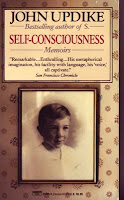
The second essay is easier to find. It is in the book "Self-Consciousness," Chapter ii. At War With My Skin. While both of these are worth reading, the second piece is more comprehensive.

Self-Consciousness can be purchased form Amazon or used from ABE Books

These are Updike's two essays on psoriasis that wer published in the New Yorker. They are available at Dermatology Central.
From the Journal of a Leper, The New Yorker, July 19, 1976, Pages 28 - 33

At War With My Skin, The New Yorker, September 2, 1985, Pages 39 - 57

New Yorker ABSTRACT: PERSONAL HISTORY telling how the writer has lived with psoriasis, a metabolic disorder that causes the epidermis, which normally replaces itself in the course of several days, to speed up the process and to produce excess skin cells. A tendency to it is inherited. The writer's mother had it and her mother had it. The disease favors the fair, the dry-skinned. It keeps you thinking. Strategies of concealment ramify and self-examination is endless. Because of his skin problem writer chose a profession that did not demand being presentable. He married young because he found a comely & gracious female who forgave him his skin. They moved to Ipswich, Mass, because the town had a great beach. Baking in the sun on the beach relieved the skin symptoms. Tells about their life in Ipswich. In August, to escape local biting flies they left and rented a house in Martha's Vineyard. In the winter he went to the Caribbean for the sun. Tells about these visits. In the fall of 1974 he left his wife and Ipswich. The next fall his skin was bad and he flew to St. Thomas but the sun did not help. At 42 he had worn out the sun At this time a few blocks from where he was living in Boston, dermatologists at Mass. Gen. Hospital were developing the PUVA program to treat psoriasis. lt was still in the experimental stage but he was accepted into the program. In a few months pills and artificial light did what salt water and sun could no longer do. His skin, was clear.