Saturday, March 24, 2012

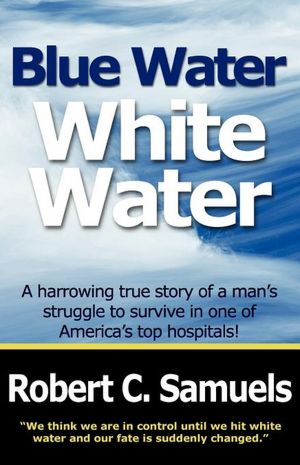
Blue Water, White Water (2011)

by Robert Samuels

Without self-pity, former New York City newspaperman and prize-winning magazine editor, Robert C. Samuels tells his own harrowing story of medical survival. He's filled it with tears, humor, love and triumph. "Audacious, brilliantly written, Blue Water, White Water, is a rare, first-person look at a world that is often closed to the average person. It is well worth your time," raves an early critic. "A riveting, vivid story!" Jan Dye Gussow, author of Growing Older: A Chronicle of Death, Life, and Vegetables. "Producers will pounce. This book IS a movie!" Carolyn Fox, Entertainment News Calendar. "Should be required reading for all medical and nursing students! A must read!" Nursing Professor Barbara Riso, R.N. "Wow! Written with an amazing ability to portray a true, horrific story that keeps readers glued to the page and laughing at the same time," Peggy Whalen, R.N. "A powerful description of genuine helplessness," Tyler Lucas, M.D.

This is an important and amazing insight into survival in a hospital setting. Chaotic and funny by turns, Samuels' story is an important one and is told with eloquence and, at times, gallows humor. DJE

There was a fine review by Abigail Zuger in the NY Times on March 12, 2012.

Going Home: Finding Peace When Pets Die (2011)

by John Katz

Jon Katz has written meaningfully about the cherished bond between humans and animals—especially our intense connection to our pets. Now, in this moving and thoughtful book, Katz addresses the difficult but necessary topic of saying goodbye to a devoted companion, and offers comfort, wisdom, and a way forward from sorrow to acceptance.

When Jon Katz first brought Orson home, he couldn’t predict how this boisterous border collie would change his life, most notably by inspiring him to buy Bedlam Farm. Yet for all of Katz’s years as a dog owner, Orson’s death shook him in a deeply profound way. “I was embarrassed by my grief,” he remembers. “What right did I have to fall to pieces over a border collie?”

Drawing on personal experiences, stories from fellow pet owners, and philosophical reflections, Katz provides guidance and support for those in mourning. By allowing ourselves to grieve honestly and openly, he posits, we can in time celebrate the dogs, cats, and other creatures that have so enriched us. With great compassion, Katz compels us to consider if we gave our pets good lives, if we were their advocates in times of need, and if we used our best judgments in the end. In dealing with these issues, we can alleviate guilt, let go, and help others who are undergoing similar passages.

Full of empathy, insight, and sage advice, Going Home is an invaluable guide and touchstone for anyone who has lost a pet. Jon Katz honors the animals that have graced our lives and reveals their truly timeless gifts: unwavering companionship and undying love.

Tuesday, February 7, 2012

ALS Researcher Dies of ALS

Dr. Richard K. Olney, a leading physician and pioneer in clinical research on amyotrophic lateral sclerosis, died of the disease on Jan. 27, 2012 at his home in Corte Madera, Calif. He was 64.

This is an important obit of a researcher/patient with ALS. It's quite ironic and one would hope that some of his writings on the subject are available.

NY Times Obituary.

San Francisco Chronicle article about Dr. Olney (April 2011)

.

Sunday, January 15, 2012

One Washcloth, One Towel

by Katey Geyer Winant

Mrs. Winant writes: "The numbing agony after losing your spouse is so overwhelming. It is so devastating. I still feel shredded. It is my wish that reading this [book] will be of benefit to other women and men who have gone through the long, dark pathway of loss. My purposes and hope is that there will be points of identification that will click and be of comfort. Each of us has our own story."

This is a short, eloquent addition to the literature on grief. Jody Kordana brilliantly reviewed "One Washcloth, One Towel" in the January 15th Berkshire Eagle.

Friday, December 2, 2011

A Bittersweet Season (2011)

by Jane Gross

As painful as the role reversal between parent and child may be for you, assume it is worse for your mother or father, so take care not to demean or humiliate them.
Avoid hospitals and emergency rooms, as well as multiple relocations from home to assisted living facility to nursing home, since all can cause dramatic declines in physical and cognitive well-being among the aged.
Do not accept the canard that no decent child sends a parent to a nursing home. Good nursing home care, which supports the entire family, can be vastly superior to the pretty trappings but thin staffing of assisted living or the solitude of being at home, even with round-the-clock help.

Important Facts
Every state has its own laws, eligibility standards, and licensing requirements for financial, legal, residential, and other matters that affect the elderly, including qualification for Medicare. Assume anything you understand in the state where your parents once lived no longer applies if they move.
Many doctors will not accept new Medicare patients, nor are they legally required to do so, especially significant if a parent is moving a long distance to be near family in old age.
An adult child with power of attorney can use a parent’s money for legitimate expenses and thus hasten the spend-down to Medicaid eligibility. In other words, you are doing your parent no favor—assuming he or she is likely to exhaust personal financial resources—by paying rent, stocking the refrigerator, buying clothes, or taking him or her to the hairdresser or barber.

This is an important book if you have aging parents. It also will be a valuable read for cognizant elderly persons.

Sunday, October 9, 2011

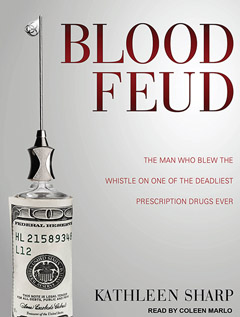
Blood Feud (2011)

by Kathleen Sharp.
Book Review on Center for Medical Consumers web site.
While this is a recurring theme, Blood Feud tells a story we all need to be reminded of. Big PhRMA is about profit not patient good. The point is: caveat emptor. The public is at risk when drug companies fight for market share.

An African proverb holds that "when elephants fight, it's the grass that suffers." This is underscored by the struggles of PhRMA giants Amgen and Ortho-Johnson and Johnson to capture the market share of Epogen and Procrit.

Blood Feud is a sobering story. A similar tale was told in "Pain Killer: A Wonder Drug's Trail of Addiction and Death" (2003) by Barry Meier that deals with Oxycontin.

This book is a thorough expose of many of the dirty tricks played by PhRMA as it pursues is goals of profit over patients' well-being. No one is allowed to stand in PhRMA's way..


Saturday, October 8, 2011

Dignifying Dementia (2011)

Elizabeth Tierney’s (E.T.’s) new book, “Dignifying Dementia” is an important addition to the literature of Alzheimer’s Disease and related disorders. It is the chronicle of a patient, Jim Tierney, as told by his wife, E.T. The book recounts Jim’s slow, steady decline from being a vibrant productive teacher and administrator to a totally dependent patient with Lewy Body Disease. Memorably, it addresses the many disconnects between the patient and his family and the health care community. No segment of the latter is untarnished. E.T.’s struggles to identify health care providers for her husband are frustrating and sad.

“The psychologist offered us chairs but never smiled… I couldn’t believe how unfriendly he seemed.” A neuropsychiatrist, when asked by E.T., “What should I do?” responded, “Don’t buy a boat of a 10,000 square foot house.”

Eventually, after much effort, E.T. assembles a caring team that treats Jim with dignity and, indeed, love. Most people would not have had E.T.’s persistence and moxie. Perhaps, that is one reason why so many dementia patients wind up in nursing homes.

Illness narratives fall into three categories: quest, restitution, chaos. Chaos is the least commonly written and the hardest to read. It may also be the most important, the truest type of pathography. Dignifying Dementia is mostly a chaos story, with an admixture of restitution made possible by the team of carers that formed around Jim. It is a memorable book that will help all of us who will be called to care for vulnerable individuals suffering from the varied forms of dementia. Order from Amazon. Kindle is only $3.99